
I will never forget the Valentine’s Day dinner four years ago that nearly made me swear off cooking high-end steak at home for good.
I had saved up and visited a local boutique butcher shop, dropping a painful amount of cash on three thick-cut, center-cut beef tenderloin steaks—true filet mignon. In my head, the evening was going to look like an upscale steakhouse: thick, succulent steaks with an aggressive, mahogany-charred crust, a warm, buttery medium-rare center, topped with a medallion of fresh herb butter slowly melting across the meat.
I thought cooking a great steak was just about cranking the heat as high as it would go.
I pulled the ice-cold filets straight out of the refrigerator, tossed them into a dry, screaming-hot nonstick skillet, and pressed them down flat with a spatula. Within two minutes, my kitchen was filled with white smoke, but when I flipped the meat over, there was no crust—just a dull, grey, wet surface. Worse, because the meat was so thick and freezing cold in the middle, I kept leaving them in the pan, waiting for the exterior to look right.
By the time I pulled them off and cut into the first steak, my heart sank.
The steaks had developed a thick, unappetizing grey band around the outer half-inch of meat, while the very center was cold, chewy, and raw. The interior juices had been driven straight out into the pan, leaving the lean tenderloin tasting dry, chalky, and flavorless. We ended up covering the expensive meat in store-bought steak sauce just to choke down each bite. I spent the rest of the evening wiping grease off my stove, feeling like I had literally set a hundred-dollar bill on fire.
That disaster forced me to study the thermodynamics of lean beef cuts. Filet mignon is cut from the tenderloin—it is the softest, most tender muscle on the animal, but it has virtually zero intramuscular fat marbling. If you treat it like a fatty ribeye, you will ruin it every single time.
The breakthrough came down to three specific techniques: tempering the meat to room temperature and salting it early to dry out the exterior, searing in heavy cast iron with high-smoke-point oil, and finishing with a cold disc of garlic-herb compound butter that melts into the hot crust as the steak rests.
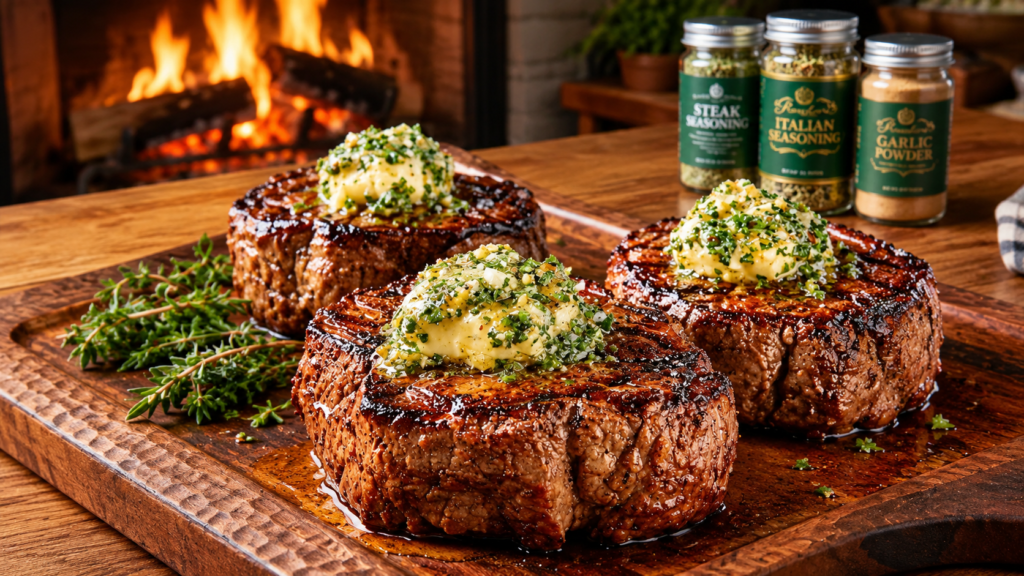
The photo above is the hard-earned victory sitting on my wooden table in front of the fireplace: three thick, perfectly seared filet mignon steaks resting on a copper platter, each crowned with a melting medallion of emerald-flecked garlic herb butter cascading down the deep-brown crust into a puddle of savory juices.
Here is how you recreate these restaurant-quality, melt-in-your-mouth steaks at home without overcooking or ending up with a rubbery grey crust.
Why Filet Mignon Goes Wrong (The Meat & Heat Physics)
Filet mignon is thick, lean, and delicate. When high heat meets low fat, standard pan-frying mistakes become fatal to your dinner:
1. The Ice-Cold Center Mistake
Because a quality filet mignon is cut between 1.5 to 2 inches thick, throwing cold meat directly into a hot pan creates a severe thermal gradient. The exterior burns and dries out before heat can even reach the middle. Letting the steaks sit on your kitchen counter for 45 to 60 minutes before cooking brings the core temperature up to room temp, allowing the meat to cook evenly from edge to center without developing that dreaded thick grey ring.
2. Surface Moisture vs. The Maillard Reaction
Water is the sworn enemy of a hard sear. If there is even a thin film of moisture on the raw meat, that water must evaporate at 212°F (100°C) before the surface can reach the 300°F+ required for the Maillard reaction. While that water is boiling off, your steak is steaming, turning pale and rubbery. Heavily salting the steaks and patting them completely bone-dry with paper towels ensures instant, blistered browning the second the beef touches hot metal.
3. The Lack of Intramuscular Fat (Why Compound Butter is Mandatory)
A ribeye has thick veins of fat that melt from within, continuously basting the muscle fibers. A tenderloin has almost none. That is why high-end steakhouses always finish filets with beef tallow or compound butter. Placing a thick slice of herb-and-garlic-infused European butter directly onto the piping-hot steak the moment it leaves the skillet coats the lean muscle fibers in rich, savory dairy fat that mimics the richness of dry-aged beef.
Ingredients & Tools You’ll Need
Essential Kitchen Gear
- 12-Inch Heavy Cast-Iron Skillet: Cast iron holds onto heat better than any other cookware. When thick cold meat hits the surface, cast iron doesn’t drop temperature, ensuring a dark, crackling crust.
- Digital Instant-Read Meat Thermometer: (A ThermoWorks ThermoPop or similar digital probe is mandatory; guessing by touch or time on an expensive cut of meat is a recipe for heartbreak).
- Heavy Metal Tongs: For turning the steaks and holding them on their sides to sear the outer circumference.
- Plastic Wrap & Small Mixing Bowl: For rolling the herb compound butter into a neat cylinder to chill.
- Heavy Serving Platter: (A warm copper or ceramic tray, like the one in the photo, catches the melted butter and pan juices during resting).
The Ingredient Breakdown
| Component | Ingredient | Quantity | Practical Role |
| The Star Beef | Center-Cut Filet Mignon (Tenderloin Steaks) | 3 steaks (approx. 8 oz each, 1.5 to 2 inches thick) | The most tender, melt-in-your-mouth cut of beef on the animal. |
| The Searing Fat | High-Smoke-Point Oil (Avocado or Ghee) | 2 tbsp | Withstands 450°F pan heat without burning or smoking off. |
| The Butter Base | High-Fat European Butter (Kerrygold or similar) | 1 stick (8 tbsp, softened to room temp) | Rich dairy base for the melting compound butter crown. |
| Aromatic Core | Fresh Garlic Cloves | 3 cloves (finely grated on a microplane) | Infuses the melting butter with sweet, pungent garlic punch. |
| Fresh Herbs | Fresh Italian Flat-Leaf Parsley | 2 tbsp (very finely minced) | Vibrant green color, crisp bite, and fresh herbal balance. |
| Fresh Herbs | Fresh Rosemary & Thyme Leaves | 1 tsp rosemary, 1 tsp thyme (finely chopped) | Woodsy, steakhouse herbs that perfume the melting butter. |
| Acid Balance | Fresh Lemon Zest | ½ tsp (finely grated) | Tiny citrus note that cuts through the heavy butterfat. |
| Base Seasoning | Coarse Kosher Salt (Diamond Crystal preferred) | 1.5 tbsp | Draws out excess surface water and seasons deep into the meat. |
| Base Seasoning | Coarse Cracked Black Pepper | 1 tbsp (freshly ground) | Creates that pebbled, savory black pepper crust. |
| Steak Seasoning | Dry Garlic-Herb Steak Rub (Optional) | 1 tsp (like the seasoning jars in the photo) | Adds savory granulated onion and paprika undertones. |
| Finishing Touch | Flaky Sea Salt (Maldon) | To taste | Sprinkled over the melting butter right before taking a bite. |
Step-by-Step Cooking Instructions
Step 1: Whip and Shape the Herb Compound Butter
Do this step first so the butter has time to firm up in the fridge while the steaks come to temperature.
In a small mixing bowl, combine:
- 8 tablespoons (1 stick) of softened unsalted European butter
- 3 cloves of finely grated fresh garlic
- 2 tablespoons of finely minced fresh parsley
- 1 teaspoon of finely chopped fresh rosemary
- 1 teaspoon of finely chopped fresh thyme
- ½ teaspoon of fresh lemon zest
- ½ teaspoon of coarse kosher salt
- ¼ teaspoon of freshly cracked black pepper
Use a fork to mash and whip the ingredients together vigorously for 60 seconds until the butter is completely uniform and speckled with vibrant green herbs.
Spoon the whipped butter onto a sheet of plastic wrap.
Use the plastic wrap to roll the butter into a tight, smooth log roughly 1.5 inches in diameter.
Twist the ends of the plastic wrap tightly to compact the cylinder.
Place the butter log into the refrigerator for at least 30 minutes (or the freezer for 15 minutes) until firm and sliceable.
Step 2: Temper and Dry-Brine the Steaks
Take your three filet mignon steaks out of the refrigerator 45 to 60 minutes before you plan to cook.
Pat the steaks completely bone-dry on all sides—including the curved outer edges—with paper towels.
Season the steaks aggressively on all surfaces with coarse kosher salt, coarse black pepper, and a light dusting of your favorite steak rub.
Use your hands to press the spices firmly into the meat fibers so they adhere.
Let the steaks sit on a wire rack or cutting board on your counter.
What Happens During This Rest: The salt initially draws out tiny droplets of moisture to the surface. As the steaks sit at room temperature, that concentrated salt brine dissolves back into the muscle tissue, seasoning the steak all the way to the core while leaving the exterior surface dry and ready for a blistered sear.
Step 3: Get the Cast Iron Screaming Hot
Set your 12-inch heavy cast-iron skillet over high heat on the stovetop.
Let the dry pan preheat for 5 full minutes.
You want the skillet radiating intense heat before any oil touches the surface.
Pour in the 2 tablespoons of high-smoke-point avocado oil or ghee.
Swirl the skillet to coat the bottom.
Wait roughly 30 seconds until the oil is shimmering and you see the very first faint wisp of smoke rising from the cast iron.
Step 4: The Hard Sear
Using heavy metal tongs, lay the three seasoned filet mignon steaks into the hot skillet, spacing them out so they do not touch.
You should hear an immediate, violent, loud sizzle.
Sear untouched for 2.5 to 3 minutes on the first side.
Do not move, poke, or press down on the steaks! Let the cast iron do its job.
Flip the steaks over using your tongs.
You should see a deep, mahogany-brown, blistered crust across the entire surface.
Sear the second side for another 2.5 minutes.
Now, use your tongs to pick up each steak and roll it onto its curved outer edge.
Hold the steak against the hot skillet for 30 to 45 seconds, rotating it until the entire outer circumference is browned and sizzling.
Step 5: The Temperature Check
Insert the probe of your digital instant-read thermometer horizontally into the center of the thickest steak:
- Rare: Pull at 118°F to 120°F.
- Medium-Rare (The Sweet Spot for Filet): Pull at 125°F to 128°F (52°C to 53°C).
- Medium: Pull at 133°F to 135°F.
Cook’s Real-Life Tip: If your steaks are extra thick (2 inches or more) and the crust is already dark brown but the internal temp is only reading 105°F, do not keep searing in the pan! Slide the entire oven-safe cast-iron skillet into a preheated 400°F (200°C) oven for 3 to 5 minutes to gently bring the center up to temperature without scorching the crust.
Step 6: The Compound Butter Crown & The 8-Minute Rest
Pull the steaks out of the hot skillet immediately and transfer them onto your wooden board or warm serving platter (exactly as seen in the photo).
Unwrap your chilled herb compound butter log.
Using a warm knife, slice the butter into thick, generous discs (about ½-inch thick).
Immediately place a cold butter round directly on top of each piping-hot seared steak (as shown in the reference image).
The Non-Negotiable Rule: Do not touch or cut into these steaks for 7 to 8 full minutes!
Straight out of the hot cast iron, the internal muscle fibers are tightly contracted, squeezing the meat juices outward.
During this mandatory resting period:
- The internal temperature will coast upward another 5°F via carryover heat, landing at an absolute textbook 130°F to 135°F medium-rare.
- The relaxed meat fibers pull the flavorful juices back into the center of the steak.
- The cold garlic-herb butter slowly softens and melts across the hot mahogany crust, cascading down the sides and mingling with the pan juices into an unctuous sauce.
Finish with a light pinch of flaky Maldon sea salt over the melting butter.
Carve into thick, tender slices with a sharp non-serrated steak knife and watch how effortlessly the blade glides through the meat.
Practical Troubleshooting & Common Mistakes
- “My steak turned grey instead of forming a dark crust.”
This happens if your pan wasn’t hot enough, or if the meat was wet when it hit the oil. Always preheat your cast iron until it wisps smoke, and make sure you dry the steaks thoroughly with paper towels before seasoning. - “The meat has a thick grey band around the center.”
This is the universal hallmark of searing meat straight out of the refrigerator. Cold beef takes too long to warm up in the middle, forcing the outer layers to overcook. Always temper your steaks on the counter for at least 45 minutes before cooking. - “The butter melted too fast and ran off the steak.”
Make sure your compound butter is thoroughly chilled in the fridge before slicing. A cold, firm medallion melts gradually, basting the crust continuously over the entire 8-minute rest rather than instantly turning to liquid and pooling on the plate.
What to Serve with Cast-Iron Filet Mignon
Because filet mignon is elegant, tender, and bathed in rich herb butter, it pairs best with classic steakhouse sides that can catch the garlic butter drippings:
- Garlic Parmesan Mashed Potatoes: Fluffy, buttery Yukon Gold mashed potatoes provide a soft bed for the sliced steak and catch every drop of the melting compound butter.
- Charred Asparagus or Broccolini: Sautéed in olive oil with a squeeze of fresh lemon juice, snappy greens provide a clean, bitter crunch that balances the rich meat and butterfat.
- Crispy Truffle Fries: Thin, crisp fries tossed with sea salt and parmesan are perfect for dipping into the steak juices on the platter.
- A Bold Red Wine: Pour a glass of Cabernet Sauvignon, Bordeaux, or Syrah. The dark fruit notes and structured tannins bond naturally with the lean beef and garlic herb butter.
Handling Leftovers (The Non-Dry Reheat)
If you happen to have a portion of filet mignon left over, wrap it tightly in foil and store it in an airtight glass container in the refrigerator for up to 3 days.
Never reheat filet mignon in the microwave! The microwave’s uneven radiation will turn this tender, delicate cut into rubbery, well-done leather in thirty seconds.
Instead, use the gentle oven method:
- Preheat your oven to 250°F (120°C).
- Place the leftover steak on a small rimmed baking sheet with a wire rack.
- Warm gently for 10 to 12 minutes just until the meat reaches room temperature and the interior is warm to the touch (around 110°F).
- Top with a fresh slice of cold herb compound butter and serve immediately.
The meat stays juicy, tender, and pink, giving you that five-star steakhouse experience all over again!