
I will never forget the Sunday holiday dinner three years back that nearly made me swear off roasting large cuts of pork forever.
I had invited family over for what was supposed to be a centerpiece roast: a thick, golden-brown boneless pork loin, glistening under a buttery garlic-herb crust, resting in a deep pan of caramelized pan juices, and perfumed with fresh thyme and rosemary. In my head, I was going to carve juicy, tender medallions at the table that looked straight out of a classic countryside tavern.
I thought cooking a pork roast was as simple as baking a whole chicken: season it, throw it in a metal roasting pan, crank the oven to 400°F so it would brown, and wait for the clock to hit an hour and a half.
When I pulled that pan out and carved into the center, my heart sank.
The exterior was scorched, and the interior was an absolute tragedy. Because boneless pork loin is an extraordinarily lean cut of meat, the high, dry oven heat had squeezed every molecule of moisture out of the muscle fibers. Instead of juicy, tender pork, I had produced a grey, chalky block that felt like chewing dry sawdust.
Worse yet, the garlic I had rubbed on the exterior had turned into bitter, blackened charred specks. When my family tried to eat it, every single bite required a frantic wash of ice water just to get it down. We ended up covering the slices in applesauce and mustard just to swallow them, and I spent the rest of the evening staring at half a dry roast sitting in my roasting pan, completely humiliated.
That disaster forced me to take a hard look at the thermodynamics of pork loin.
Pork loin is cut from the back of the pig—it is not pork shoulder (pork butt). It does not have webs of intramuscular connective tissue or collagen to melt into gelatin over hours of heat. If you overcook pork loin even by five degrees, it turns into leather.
The breakthrough came down to three specific culinary rules: you must salt and temper the roast so it cooks evenly, you need a two-temperature roasting strategy (searing high for color, then dropping low to coast gently), and you must protect the lean meat with a thick blanket of garlic-herb compound butter and aromatic pan broth to baste the cut continuously.
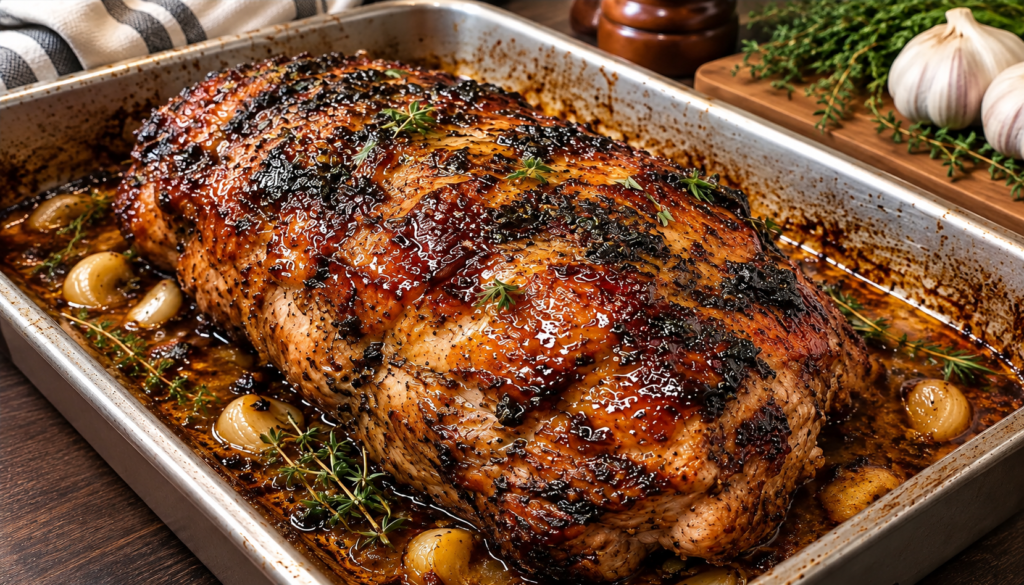
The photo above is the hard-won standard resting on my wooden board: a massive, perfectly roasted boneless pork loin sitting in a rimmed metal baker, coated in a deep mahogany, caramelized garlic-herb crust flecked with fresh thyme sprigs, resting in bubbling savory pan drippings alongside sweet braised shallots and garlic cloves.
Here is how you make this show-stopping, melt-in-your-mouth Garlic Herb Roasted Pork Loin at home without drying out a single slice.
Why Roasted Pork Loin Turns Dry and Tough (The Lean Meat Science)
Pork loin has a reputation for being dry, but that is entirely human error. When high heat meets lean animal protein, the physics of muscle fibers will punish you:
1. The Outdated 160°F Internal Temp Rule
For decades, home cooks were told that pork must be cooked to 160°F (71°C) or higher. That old advice guaranteed dry, fibrous meat. The USDA updated guidelines to a safe 145°F (63°C) with a mandatory 3-minute rest. At 145°F, pork loin is juicy, succulent, and faintly blushing pink in the very center. If you leave a pork loin in the oven until it hits 160°F, carryover heat will push it to nearly 170°F, turning the lean muscle into dry cardboard. Pulling the roast when the thermometer hits 140°F (60°C) allows carryover heat to glide it to the perfect 145°F finish during resting.
2. Confusing Pork Loin with Pork Tenderloin
Pork tenderloin is a small, long, pencil-thin cut (usually 1 to 1.5 pounds) that cooks in twenty minutes. A boneless center-cut pork loin (pictured in the reference photo) is a wide, thick, heavy roast (usually 3.5 to 5 pounds) with a protective fat cap running along the top. Cooking a thick loin requires sustained, gentle heat so the center cooks through before the exterior dries out.
3. Searing Away from Moisture
If you roast a lean loin on a flat dry tray, the exterior dries out long before the center warms up. Placing the roast over a bed of whole garlic cloves, shallots, and a splash of white wine and chicken bone broth in a high-sided pan creates a localized steam bath. The rising steam keeps the sides of the roast moist, while the top fat cap renders, basting the meat in melted herb butter and drippings.
Ingredients & Tools You’ll Need
Essential Kitchen Gear
- Rimmed Metal Roasting Pan or High-Sided Sheet Baker: (A sturdy rectangular aluminum or stainless baker, like the one in the photo, holds the pan drippings, shallots, and wine jus without crowding the roast).
- Digital Instant-Read Meat Thermometer (or Leave-In Probe): (A ThermoWorks ThermoPop or ChefAlarm is non-negotiable; guessing pork doneness by time is the #1 cause of dry meat).
- Kitchen Butcher’s Twine: For tying the pork loin every 1.5 inches to ensure an even, compact cylinder that cooks uniformly from end to end.
- Small Mixing Bowl & Silicone Spatula: For blending the garlic-herb butter spread.
- Sharp Carving Knife: A long, non-serrated blade ensures you can slice paper-thin or thick medallions without tearing the tender crust.
The Ingredient Breakdown
| Component | Ingredient | Quantity | Practical Role |
| The Star Roast | Center-Cut Boneless Pork Loin (with fat cap) | 3.5 to 4.5 lbs (trimmed) | Plump, lean loin; fat cap bastes the roast as it renders. |
| The Butter Shield | Unsalted High-Fat Butter (Softened) | 6 tbsp (¾ stick) | Carries aromatics and seals the top to prevent moisture loss. |
| Aromatic Core | Fresh Garlic Cloves | 8 to 10 cloves (6 minced, 4 left whole) | Minced garlic builds the crust; whole cloves roast in the pan jus. |
| Aromatic Core | Fresh Shallots or Pearl Onions | 3 to 4 whole (halved) | Melts down in the pan bottom into sweet, caramelized bites. |
| Fresh Woodsy Herbs | Fresh Thyme & Rosemary | 2 tbsp fresh thyme, 1 tbsp minced rosemary | Traditional French/Italian roast herbs that perfume the meat. |
| Savory Umami | Dijon Mustard | 1.5 tbsp | Acts as an emulsifying glue that helps the herb butter cling to the meat. |
| Savory Booster | Worcestershire Sauce | 1 tbsp | Adds fermented savory depth to the pan drippings. |
| The Deglazing Jus | Dry White Wine (or Apple Cider) | ½ cup (Pinot Grigio or Sauvignon Blanc) | Cuts through the butterfat and dissolves pan fond into a jus. |
| The Liquid Base | Low-Sodium Chicken Bone Broth | ¾ cup | Creates the moist pan environment to prevent drippings from scorching. |
| Dry Rub Seasoning | Garlic Powder, Onion Powder, Smoked Paprika | 1 tsp each | Builds an initial savory, golden-mahogany crust under the butter. |
| Base Seasoning | Coarse Kosher Salt & Cracked Black Pepper | 1.5 tbsp salt, 1 tbsp coarse black pepper | Mandatory seasoning across the exterior fat cap and pan drippings. |
| Finishing Touch | Fresh Thyme Sprigs | 4 to 5 sprigs | Laid over the sizzling roast for that rustic tavern presentation. |
Step-by-Step Cooking Instructions
Step 1: Trim, Score, and Tie the Pork Loin
Take your pork loin out of the refrigerator 45 to 60 minutes before you plan to roast it.
Never roast a cold pork loin straight from the fridge! An ice-cold center forces the exterior to overcook and turn grey before the inside reaches temperature.
Set the pork loin fat-cap facing up on your cutting board.
Inspect the fat cap: you want an even layer roughly ¼-inch thick. If the butcher left a massive, thick fat slab, trim away the excess so it renders easily.
Using a sharp chef’s knife, lightly score the fat cap in a shallow diamond crosshatch pattern, cutting just through the fat without puncturing the red meat beneath.
Why Scoring Matters: Scoring gives the rendered fat a pathway to melt across the roast, while creating deep pockets for your garlic-herb butter to sink into.
Cut 3 to 4 lengths of kitchen twine. Tie the roast firmly at 1.5-inch intervals down the length of the meat.
Pork loin naturally flattens out as it relaxes; tying it binds the muscle into a uniform, tight cylinder so it roasts evenly from end to end.
Pat the roast completely bone-dry with paper towels.
Season all sides aggressively with 1 tablespoon of coarse kosher salt, coarse black pepper, garlic powder, onion powder, and smoked paprika. Press the spices into the scored fat grooves.
Step 2: Whip the Garlic-Herb Butter Blanket
In a small bowl, combine:
- 6 tablespoons of softened unsalted butter
- 6 cloves of finely minced fresh garlic
- 1.5 tablespoons of Dijon mustard
- 1 tablespoon of Worcestershire sauce
- 1.5 tablespoons of finely chopped fresh thyme leaves
- 1 tablespoon of finely chopped fresh rosemary leaves
- ½ teaspoon of coarse black pepper
Mash with a fork or silicone spatula until you have a thick, fragrant, emulsified paste.
Smear this garlic-herb butter generously over the entire scored fat cap and sides of the seasoned pork loin, packing it down into the diamond cuts.
Step 3: Prep the Roasting Pan
Preheat your oven to 425°F (220°C).
Take your heavy rimmed roasting pan or high-sided baking dish.
Scatter your halved shallots and the remaining whole peeled garlic cloves across the bottom of the pan.
Pour in the ½ cup of dry white wine and ¾ cup of chicken bone broth.
Set the seasoned, butter-crusted pork loin directly in the center of the pan, resting fat-cap facing UP (exactly as seen in the photo).
The base of the roast will sit in a shallow layer of broth and aromatics, while the buttered fat cap stays completely exposed to the heat.
Step 4: The High-Heat Blast (Color & Searing)
Slide the roasting pan onto the center rack of your preheated 425°F (220°C) oven.
Roast uncovered for 18 to 20 minutes.
During this initial high-heat blast, the garlic butter melts into the scored grooves, the fat cap begins to sizzle and render, and the surface sugars caramelize into that deep, dark mahogany bark visible in the reference photo.
Step 5: The Gentle Low-Heat Braise
After 20 minutes, turn the oven temperature dial down to 325°F (165°C).
Do NOT open the oven door during the transition! Let the oven gently cool down to the lower temperature.
Continue roasting at 325°F for 35 to 45 minutes.
Around the 35-minute mark of this second phase, slide the probe of your digital instant-read thermometer into the dead center of the thickest part of the roast:
- Target Pull Temperature: 140°F (60°C).
The Non-Negotiable Temperature Rule: Do not wait until the thermometer reads 145°F in the oven! A thick roast carries enormous thermal momentum. If you pull it at 140°F, residual heat will coast the center up to an absolute textbook, juicy 145°F during the rest period.
The moment the display hits 140°F, pull the roasting pan out of the oven immediately using heavy heatproof mitts.
Step 6: The Mandatory 15-Minute Rest
Set the hot metal roasting pan onto a wooden board or heatproof trivet.
Gently lay fresh sprigs of thyme across the sizzling, bubbling crust of the pork loin.
Tuck the sweet braised shallots and soft roasted garlic cloves around the base.
Cook’s Real-Life Tip: Do not cut into this roast right now!
Straight out of the oven, the muscle fibers are under intense thermal tension, and the internal juices are boiling hot.
If you slice into the loin immediately, all the moisture will pour out into the pan, leaving the interior dry and pale.
Let the roast rest undisturbed in the pan for 15 full minutes.
During this rest:
- Carryover heat finishes cooking the core safely to 145°F.
- The muscle fibers relax, reabsorbing the flavorful internal juices throughout the meat.
- The rendered fat and herb butter in the bottom of the pan blend with the reduced white wine and broth into a rich, savory pan jus.
Step 7: Carve and Table Presentation
Snip and discard the kitchen twine using kitchen shears.
Using a long, razor-sharp carving knife, slice the pork loin crosswise into clean medallions—roughly ½-inch thick.
Look at the meat: it should be glistening, moist, and tender, with an amber-mahogany, caramelized garlic crust along the top edge.
Transfer the sliced medallions onto dinner plates.
Spoon the bubbling garlic-herb pan jus from the bottom of the roasting pan generously over each slice, serving with the sweet roasted shallots and tender whole garlic cloves.
Practical Troubleshooting & Common Mistakes
- “My pork loin turned out dry and chalky.”
This happens if you cooked the roast past 145°F internal temperature. Pork loin is exceptionally lean and cannot handle overcooking. Always use a digital probe thermometer, pull the roast at 140°F, and let carryover heat during the 15-minute rest do the rest of the work. - “The garlic on top burned black.”
Garlic burns easily if placed dry under high heat. That is why we mix the minced garlic into softened butter and Dijon mustard. The butterfat coats the garlic particles, protecting them from scorching while encouraging golden caramelization. - “The pan drippings burned on the bottom of the pan.”
Always make sure you add that ½ cup of wine and ¾ cup of broth to the bottom of the pan in Step 3. If your oven runs hot and the liquid evaporates completely during roasting, splash in another ¼ cup of broth to keep the pan juices from burning.
Delicious Flavor Upgrades & Variations
While this classic French/Italian garlic herb butter profile is the ultimate crowd-pleaser, you can easily customize the flavor:
- The Sweet Apple Bourbon Glaze: Add 2 tablespoons of dark brown sugar and 2 tablespoons of bourbon to the herb butter mixture. Swap the white wine in the pan for unfiltered apple cider.
- The Rosemary Garlic Balsamic Twist: Add 2 tablespoons of aged balsamic vinegar to the pan jus and brush the top of the fat cap with a light balsamic glaze during the final ten minutes of roasting.
- The Stuffed Pork Loin: Butterfly the roast open, spread a layer of baby spinach, prosciutto, and shredded fontina cheese across the center, roll it back into a tight cylinder, tie it with twine, and roast as directed.
What to Serve with Garlic Herb Roasted Pork Loin
This savory, succulent pork roast produces an abundance of rich, wine-and-butter pan jus, making it the perfect centerpiece for comforting, absorbent sides:
- Garlic Parmesan Mashed Potatoes: Fluffy Yukon Gold mashed potatoes provide a comforting bed for the sliced pork and catch every drop of that savory herb pan jus.
- Roasted Root Vegetables: Roasted carrots, parsnips, and sweet potatoes tossed in olive oil and rosemary complement the savory pork flavors.
- Crisp Green Beans or Roasted Broccolini: Tossed with olive oil, sea salt, and a squeeze of fresh lemon juice, snappy greens provide a clean, refreshing crunch that balances the rich butterfat.
- A Crisp, High-Acid Wine: A chilled dry Riesling, Pinot Noir, or unoaked Chardonnay cuts through the rich butter and highlights the sweet, savory garlic notes in the roast.
Storing and Reheating Leftovers (The Non-Dry Method)
Leftover pork loin can be notoriously difficult to reheat without drying out the lean meat fibers.
Store leftover sliced pork submerged in its pan jus inside an airtight glass container in the refrigerator for up to 4 days. The liquid keeps the meat fibers hydrated while chilled.
Never reheat sliced pork loin in the microwave on high power! The microwave will instantly boil the remaining moisture out of the meat, leaving you with dry, rubbery medallions.
Instead, use your stovetop skillet or a toaster oven:
- Place your leftover pork slices and a few spoonfuls of pan jus into a skillet over medium-low heat.
- Splash in 1 to 2 tablespoons of chicken broth or water and cover with a tight lid.
- Warm gently for 4 to 5 minutes just until the meat is heated through.
The pork will remain juicy, tender, and succulent, giving you that tavern-quality roast dinner all over again with practically zero effort!