
I will never forget the chilly, drizzly Thursday evening three winters ago that nearly made me ban cabbage from my slow cooker forever.
I had been daydreaming all day about classic Eastern European stuffed cabbage rolls—the kind where savory beef, tender rice, and sweet braised cabbage meld together in a rich, tangy tomato-garlic sauce. But rolling dozens of slippery, scalding cabbage leaves on a busy weeknight is practically an Olympic sport nobody has time for. So, like many home cooks looking for a shortcut, I decided to make an “unstuffed” slow-cooker version.
I figured it was as simple as dumping everything into the pot and letting it ride. I chopped up a whole head of raw green cabbage, dumped raw ground beef and uncooked white rice straight on top, poured two whole jars of thin marinara and two cups of beef broth over everything, clamped the glass lid down, set it to Low, and went to work.
When I stepped through the front door nine hours later, my heart sank.
Instead of an appetizing, savory aroma, the entire first floor of my house smelled like an unventilated high school cafeteria serving boiled greens. When I walked over to the kitchen island and pulled off the lid, the scene inside was an absolute culinary heartbreak.
The cabbage had dumped its natural moisture into the pot, turning the sauce into a pale, watery pink swamp with an unappealing layer of grey meat scum and beef tallow floating on top. Worse, the raw rice had absorbed the diluted tomato water unevenly—some grains were chalky and hard, while others had turned into gummy mush. The unbrowned beef looked like pale grey pellets, and the cabbage was limp, stringy, and sour.
When my family tried to eat it, we had to fish out spoonfuls with slotted spoons just to avoid drinking cabbage water off our dinner plates. We ended up ordering takeout Chinese food at 8:30 PM, and I spent twenty minutes dumping eight quarts of watery mush into the garbage.
That flop bugged me for weeks. Unstuffed cabbage casserole should be the holy grail of weeknight comfort food: hearty, budget-friendly, high in fiber, and packed with savory richness.
The failure came down to a total disregard for cabbage cellular biology, starch hydration, and meat searing. A slow cooker does not evaporate liquid. When you combine high-water vegetables with wet sauces and raw ground beef, you are effectively boiling your dinner in grey water.
Once I learned to brown the beef with aromatics and tomato paste first, par-cook the rice so it doesn’t rob the sauce of moisture, restrict added liquid to just a concentrated splash, and layer the ingredients strategically like a rustic lasagna, everything changed.
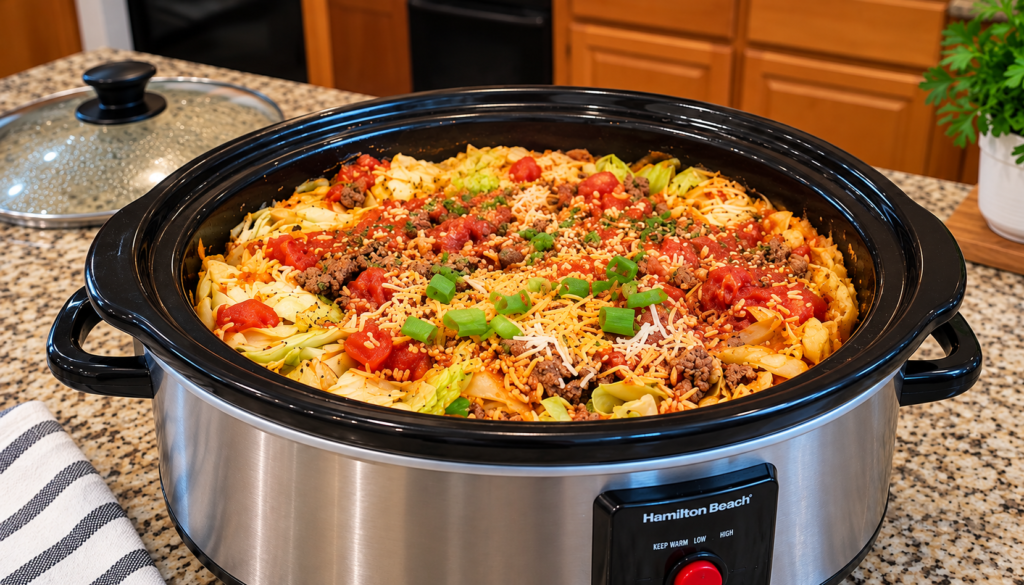
The photo above is the hard-won standard sitting on my granite counter: an oval stainless-steel slow cooker packed to the brim with tender cabbage ribbons, juicy seasoned beef crumbles, fluffy rice, and rich crushed tomatoes, garnished with freshly sliced scallions and ready to be ladled out with a silver soup ladle.
Here is how you make this foolproof, soul-warming Unstuffed Cabbage Roll Casserole at home without ending up with a watery mess or that dreaded sulfur smell.
Why Slow-Cooker Cabbage Casseroles Fail (The Science of Moisture and Starch)
Cabbage, ground beef, and rice are all fantastic slow-cooker ingredients, but they operate on completely conflicting moisture schedules:
1. The 92% Water Trap (The Cabbage Sweat)
A whole head of green cabbage feels heavy, solid, and dense, but it is roughly 92% water by weight. In an enclosed slow cooker with a locked lid, that water cannot evaporate into the kitchen. As the heat breaks down the plant’s cell walls, the cabbage collapses and expels cups of liquid into the pot. If you start with two or three cups of broth, you end up with a diluted soup. You only need ½ cup of concentrated broth; the cabbage itself will create the rest of the braising liquid as it cooks down.
2. The Raw Rice Sponge Dilemma
Throwing raw, uncooked white rice directly into a slow-cooker casserole is a dangerous gamble. Rice requires high heat and a specific 2:1 liquid ratio to hydrate. Furthermore, tomato acid actively slows down starch gelatinization. If you put dry rice into tomato sauce in a slow cooker, the grains stay hard and gritty for hours, or they swell into a mushy paste that clouds the sauce. Using par-cooked (or leftover chilled) rice folded in ensures every grain stays distinct, fluffy, and tender without fighting the acidity of the tomatoes.
3. The Sulfur Gas Buildup
Brassicas contain sulfur compounds called glucosinolates. When cooked too long in stagnant water under a tight lid, those compounds break down into pungent hydrogen sulfide and isothiocyanates. Sautéing the beef and onions with a splash of apple cider vinegar, a touch of brown sugar, and tomato paste creates an acidic, sweet barrier that tames the sulfur funk, bringing out the cabbage’s natural sweetness instead.
Ingredients & Tools You’ll Need
Essential Kitchen Gear
- 6- to 7-Quart Oval Slow Cooker: (A large slow cooker, like the stainless-steel unit in the photo, provides the surface area needed to layer cabbage and meat evenly so the heat penetrates uniformly).
- 12-Inch Heavy Skillet: Mandatory for browning the ground beef, rendering excess fat, and blooming the tomato paste and spices.
- Meat Chopper or Wooden Spoon: For breaking the beef into fine, uniform crumbles.
- Large Soup Ladle: (Like the deep stainless-steel ladle shown in the photo, for lifting generous portions out of the pot).
- Sharp Chef’s Knife: For chopping a dense head of cabbage into bite-sized 1.5-inch ribbons.
The Ingredient Breakdown
| Component | Ingredient | Quantity | Practical Role |
| The Star Vegetable | Fresh Green Cabbage | 1 large head (approx. 2.5 to 3 lbs, cored and chopped into 1.5-inch pieces) | Sweats down into sweet, tender ribbons that form the body of the casserole. |
| The Savory Meat | Ground Chuck (85/15) or Beef/Pork Blend | 1.5 to 2 lbs (700g to 900g) | Delivers robust, juicy flavor without leaving an oily grease slick. |
| The Fluffy Grain | Long-Grain White Rice or Jasmine Rice | 1.5 cups (par-cooked or cooked and cooled) | Absorbs savory meat juices without stealing moisture from the sauce. |
| Aromatic Base | Sweet Yellow Onion | 1 large (finely diced) | Sautéed with the beef to build natural sweetness and moisture. |
| Aromatic Punch | Fresh Garlic Cloves | 5 to 6 cloves (minced) | Delivers bold, savory depth to the tomato sauce. |
| The Rich Tomato Core | Crushed San Marzano Tomatoes | 1 can (28 oz) | Thick, sweet tomato foundation that won’t turn watery. |
| Tomato Engine | Tomato Paste | 3 tbsp | Concentrated tomato umami that thickens the braising liquid. |
| The Sweet-Tart Balance | Apple Cider Vinegar & Brown Sugar | 1.5 tbsp vinegar, 1 tbsp brown sugar | Recreates that authentic, sweet-and-sour Polish/Ukrainian cabbage roll profile. |
| Savory Booster | Worcestershire Sauce | 2 tbsp | Adds fermented umami depth that elevates the ground beef. |
| The Steam Liquid | Low-Sodium Beef Bone Broth | ½ cup | Minimal liquid needed to start the steam cycle without flooding the pot. |
| Herbal Backbone | Italian Seasoning & Smoked Paprika | 1 tbsp Italian blend, 1.5 tsp smoked paprika | Classic aromatic warmth that colors the sauce and beef. |
| Base Seasoning | Coarse Kosher Salt & Black Pepper | 1.5 tbsp salt (divided), 1 tbsp cracked black pepper | Crucial seasoning across the cabbage, meat, and sauce layers. |
| Fresh Finish | Green Onions (Scallions) | 3 stalks (thinly sliced) | Adds crisp, mild onion crunch and vibrant green contrast on top. |
Step-by-Step Cooking Instructions
Step 1: Prep and Chop the Cabbage
Peel off and discard the two tough, discolored outer leaves of your green cabbage.
Set the cabbage stem-side down on a stable cutting board.
Cut the head clean in half through the center of the stem, and then cut each half into quarters.
Slice out the dense, pale, triangular core from each quarter and discard it.
Chop the cabbage leaves into bite-sized squares or ribbons—roughly 1.5 inches wide.
Do not shred it too finely like coleslaw! Cabbage shrinks down by over half its volume during a multi-hour braise. Cutting it into sturdy chunks ensures it keeps a pleasant, tender bite rather than disintegrating into baby food.
Place the chopped cabbage in a large bowl, toss with 1 teaspoon of coarse kosher salt, and set it aside while you cook the beef.
Step 2: Brown the Beef and Build the Meat Sauce
Place your 12-inch heavy skillet over medium-high heat on the stovetop.
Add your ground chuck (or beef-and-pork blend) and the finely diced sweet yellow onion.
Use your meat chopper to break the beef apart into fine, uniform crumbles.
Cook for 6 to 8 minutes until the meat is thoroughly browned and the onions are soft and translucent.
Stir in the minced fresh garlic and cook for 60 seconds just until fragrant.
Tilt the skillet and carefully spoon out all excess rendered grease (leaving about 1 tablespoon in the pan).
Turn the heat down to medium-low.
Add the 3 tablespoons of tomato paste, Italian seasoning, smoked paprika, 1.5 teaspoons of kosher salt, and 1 teaspoon of cracked black pepper.
Cook the tomato paste and spices directly against the hot metal for 2 minutes, stirring constantly.
This blooms the spices and caramelizes the tomato paste into a rich, dark brick-red glaze that removes any raw, tinny flavor.
Stir in the 2 tablespoons of Worcestershire sauce, 1.5 tablespoons of apple cider vinegar, and 1 tablespoon of brown sugar.
Remove the skillet from the heat source.
Fold the 1.5 cups of par-cooked rice directly into the skillet with the seasoned beef, tossing until the grains are coated in the savory red mixture.
Step 3: Layer the Slow Cooker (The Lasagna Method)
Take your 6- to 7-quart oval slow cooker insert.
Pour the ½ cup of low-sodium beef bone broth directly into the bottom of the crock.
Now, build alternating layers (just like assembling a lasagna):
- The First Cabbage Layer: Spread roughly one-third of your chopped raw cabbage across the bottom of the crock.
- The First Meat & Rice Layer: Spoon half of the warm beef and rice mixture evenly over the cabbage.
- The Tomato Layer: Pour about one-third of the canned crushed tomatoes over the meat.
- The Second Cabbage Layer: Add another one-third of the chopped cabbage, pressing down gently with your hands to compact the layers.
- The Second Meat & Rice Layer: Spoon the remaining beef and rice mixture over the cabbage.
- The Final Crown: Top with the remaining chopped cabbage, and pour the rest of the crushed tomatoes evenly across the very top.
Why This Layering Works: Layering prevents the dense beef and rice from compacting into a solid block at the bottom of the pot. As the cabbage cooks and releases its sweet juices, the moisture filters downward through the seasoned meat and rice, circulating flavor throughout the entire crock.
Step 4: The Low-and-Slow Braise
Clamp the heavy glass lid onto the slow cooker.
- Low Setting (Strongly Recommended): Cook for 6 to 7 hours.
- High Setting: Cook for 3.5 to 4 hours.
The Non-Negotiable Rule: Keep the lid closed! For the first four hours, do not open the cooker to stir. Every time you remove the lid, you dump trapped steam and drop the internal temperature, extending your cooking time by 20 minutes.
Around hour 6 on Low, lift the lid. You will see that the mountain of chopped cabbage has collapsed into a luscious, bubbling, savory casserole, with rich tomato juices simmering up through the center.
Pierce a piece of cabbage with a fork: it should be silky, tender, and translucent, with zero toughness or rubbery resistance.
Step 5: The Gentle Fold & Rest
Take a large wooden spoon and gently fold the casserole from the bottom upward two or three times to distribute the rice, beef crumbles, and tender cabbage evenly throughout the sauce.
Do not aggressively whip or mash it! Keep the folds gentle so the rice grains stay intact.
Taste a spoonful:
- It should be savory, rich, sweet from the braised cabbage and onion, and balanced by that subtle, tangy tomato acidity.
- Add an extra pinch of kosher salt or a crack of black pepper if desired.
Switch the slow cooker setting to “WARM”.
Scatter your freshly sliced green onions (scallions) across the top for that bright, crisp green garnish seen in the reference photo.
Let the casserole rest with the lid off for 5 to 8 full minutes before serving.
During this brief pause, the simmering bubbles settle, and the par-cooked rice absorbs just enough of the hot pan juices to lock the sauce into a thick, spoon-coating consistency rather than a runny soup.
Step 6: Ladle and Table Service
Set your slow cooker right onto the counter or dining table with a wooden trivet underneath.
Using your deep stainless-steel ladle (exactly as seen in the action shot), scoop deep into the crock, lifting generous, steaming portions of beef, cabbage, rice, and tomato sauce into wide, shallow dinner bowls.
Serve piping hot!
Practical Troubleshooting & Common Mistakes
- “My casserole turned out watery like soup.”
This happens if you added too much broth at the start, or used watery diced tomatoes instead of crushed San Marzano tomatoes. Remember, cabbage releases cups of its own liquid! Stick strictly to ½ cup of broth. If you open the crock and find too much liquid, switch the slow cooker to High with the lid completely off for 20 minutes to let the excess steam evaporate, or stir in an extra half-cup of cooked rice to absorb the broth. - “The rice turned to mush.”
Never use instant “minute rice” in a slow cooker! Minute rice breaks down into a pasty glue within thirty minutes of heat. Use regular long-grain white rice or jasmine rice, and par-cook it (boiled for just 8 minutes until slightly firm) before folding it into the beef. - “The cabbage smells bitter and funky.”
This is the hallmark of cooking raw cabbage without enough acid or browning. Always brown your beef with tomato paste, onions, and garlic, and make sure you include that tablespoon of apple cider vinegar. The acid neutralizes bitter sulfur compounds, leaving the cabbage sweet and mellow.
Delicious Upgrades & Variations
While this classic beef and rice unstuffed cabbage recipe is the ultimate homestyle comfort food, you can easily tweak it:
- The Smoked Sausage & Pork Twist: Swap half of the ground beef for ground pork or sliced smoked Polish kielbasa. The smoky paprika and garlic in the sausage take the flavor to another level.
- The Low-Carb Keto Version: Omit the rice entirely, or swap it for 2 cups of riced cauliflower. Fold the cauliflower in during the final 45 minutes of cooking so it retains a pleasant, tender bite.
- The Melted Cheese Crown: Right after folding the casserole in Step 5, blanket the top with 1.5 cups of shredded sharp white cheddar or mozzarella, pop the lid back on for 5 minutes until molten and bubbly, and garnish with scallions.
What to Serve with Unstuffed Cabbage Casserole
This dish is a complete, balanced meal in a single bowl—packing protein, vegetables, and complex carbohydrates—but it pairs wonderfully with simple rustic sides:
- A Big Dollop of Cold Sour Cream: The traditional Eastern European way! Stirring a heaping spoonful of cold, tangy sour cream directly into the steaming bowl of tomato-beef cabbage creates a rich, creamy pink sauce that is out of this world.
- Warm Crusty Rye or Sourdough Bread: Mandatory for swiping the bottom of your bowl clean of every drop of savory tomato-meat jus.
- Crisp Cucumber and Dill Salad: Thinly sliced English cucumbers tossed with white vinegar, olive oil, and fresh dill provide a crisp, refreshing crunch that cuts through the rich, warm stew.
- A Cold Pilsner or Amber Ale: The crisp maltiness of an amber ale or clean German pilsner balances the sweet-and-sour tomato broth effortlessly.
Storing and Reheating Leftovers (The Next-Day Magic)
Here is the honest truth about cabbage casseroles: they taste even better on day two and day three.
As the casserole chills in the refrigerator overnight, the tender cabbage ribbons continue to absorb the garlic, Worcestershire, and tomato seasonings, while the rice stabilizes into a wonderfully cohesive texture.
Transfer leftovers to an airtight glass container and store in the refrigerator for up to 4 to 5 days.
How to Reheat Properly:
- On the Stovetop: Place your desired portion into a small saucepan over medium-low heat. Splash in 2 tablespoons of water or beef broth to loosen the sauce. Cover and warm gently for 5 to 6 minutes, stirring occasionally, until steaming hot.
- In the Microwave: Scoop into a microwave-safe bowl, cover loosely with a paper towel to trap steam, and reheat on medium power for 2 to 3 minutes, stirring halfway through.
Top with a fresh pinch of green onions and a dollop of sour cream, and enjoy an effortless, hearty comfort meal that warms you all the way down to your toes!