
I will never forget the stormy Friday night three autumns back that nearly convinced me to pack up my slow cooker and relegate it to the basement storage shelf forever.
I was aiming for the ultimate all-in-one comfort feast: thick, meaty country-style pork ribs coated in a sticky, glossy honey garlic glaze, slow-braised until fork-tender alongside crispy, golden potato bites. In my head, I envisioned lifting the lid to find perfectly blistered, sticky ribs and intact, seasoned roasted potatoes ready to plate straight from the crock.
I assumed slow cookers were foolproof “dump-and-go” machines. I took cold, unseared pork rib portions straight out of the plastic butcher wrap, cut russet potatoes into small cubes, piled them haphazardly into the black ceramic insert, dumped a cup of honey, soy sauce, and two cups of chicken broth over the top, clamped down the lid, and turned the dial to High.
Five hours later, dinner was an unmitigated culinary disaster.
The russet potatoes had completely collapsed into a watery, gritty mash that clouded the bottom of the pot. Worse yet, because I hadn’t seared the pork ribs and had drowned them in excess liquid, they hadn’t caramelized at all—they were pale, rubbery, and tasted like boiled pork stewed in sugary water. When I tried to pull a rib out with tongs, the flabby, unrendered fat cap slipped off into the liquid, leaving behind dry, stringy meat fibers. My family quietly pushed the mushy potato sludge around their plates, and we ended up eating frozen waffles at 9:00 PM while I spent twenty minutes scraping scorched honey sludge out of the ceramic dish.
That embarrassing dinner forced me to rethink how pork and root vegetables interact inside a sealed, high-humidity appliance.
Pork ribs contain connective tissue and fat caps that demand high dry heat to render and develop color. Potatoes need radiant heat to crisp up, but will quickly dissolve if submerged in braising broth for hours.
The secret comes down to three repeatable kitchen rules: giving the seasoned ribs a blistering skillet sear to build an initial Maillard crust, using waxy Yukon Gold potatoes arranged high along one side of the crock so they steam and roast without boiling in meat drippings, and applying a concentrated honey-garlic reduction with a fast broiler char right before serving.
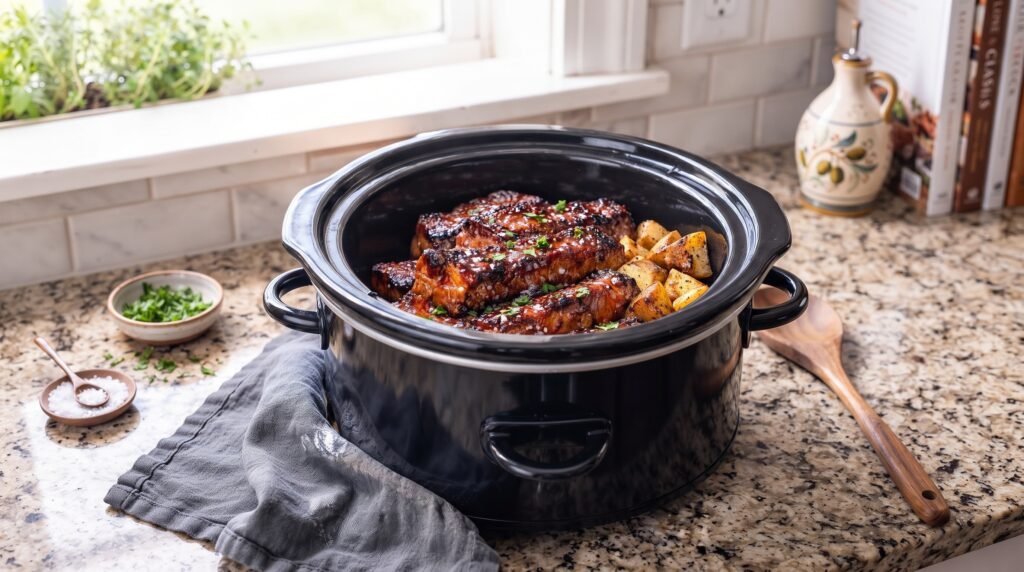
The photo above is the hard-won standard sitting on my counter: five thick, deeply caramelized, glazed pork rib portions resting in a slow cooker next to a neat cluster of golden, intact roasted potato bites, finished with a glossy lacquer, flaky salt, and fresh herbs.
Here is how you recreate these restaurant-level slow-cooker honey garlic pork ribs and potatoes at home without a single bite of mush or flabby meat.
Why “Dump-and-Cook” Pork and Potatoes Fail (The Kitchen Science)
Cooking meat and starchy root vegetables together inside a closed steam chamber requires careful moisture and heat management:
1. The Russet vs. Yukon Gold Starch Trap
Russet potatoes are high-starch, low-moisture tubers with delicate cellular walls. When submerged in simmering braising liquid for multiple hours, their cells swell with water, burst, and disintegrate into a gritty paste. Yukon Gold or baby yellow potatoes contain higher levels of waxiness and lower amylose starch. Their cell walls remain structurally intact under long-term heat, yielding a creamy, melt-in-your-mouth interior while keeping sharp, clean, golden roasted edges.
2. The Unrendered Pork Fat Cap
Country-style pork ribs (cut from the pork shoulder or loin) carry substantial exterior fat and collagen. A slow cooker’s internal environment hovers around 200°F (93°C) under 100% humidity, which is incapable of crisping or browning fat. Searing the ribs in a smoking-hot skillet for 2 to 3 minutes per side renders the tough surface fat and creates hundreds of savory flavor compounds through the Maillard reaction. This ensures the meat stays juicy rather than turning into flabby, boiled pork.
3. The Condensation Flood
A slow cooker does not permit evaporation. As the pork cooks, it releases roughly 20% of its internal weight in moisture. If you pour cups of broth into the crock at the start, you create a pool of diluted, sugary water. You need only ⅓ to ½ cup of liquid to start; the pork drippings, melting honey, and aromatics will create their own concentrated braising jus without turning your potatoes into soup.
Ingredients & Tools You’ll Need
Essential Gear
- 6- to 7-Quart Oval Slow Cooker: (An oval ceramic slow cooker provides the elongated base needed to keep the ribs laid flat in a single row while keeping the potatoes partitioned to one side).
- 12-Inch Heavy Cast-Iron Skillet: Mandatory for getting a deep, sizzling sear on the pork ribs before they enter the slow cooker.
- Large Metal Tongs: For turning heavy, sizzling meat portions without puncturing the fibers.
- Small Saucepan & Whisk: For boiling the slow-cooker juices into an ultra-thick, sticky table glaze.
- Silicone Basting Brush: For lacquering the honey-garlic glaze over the meat.
The Ingredient Breakdown
| Component | Ingredient | Quantity | Practical Role |
| The Star Meat | Country-Style Pork Ribs (Bone-in or Boneless) | 3 to 3.5 lbs (approx. 5 thick cut portions) | Rich in marbling; braises into fork-tender, succulent slabs. |
| The Potato Side | Yukon Gold or Dutch Yellow Potatoes | 1.5 lbs (cut into 1-inch uniform cubes) | Waxy spuds that hold their shape and roast without crumbling. |
| The Searing Fat | High-Smoke-Point Oil | 2 tbsp (avocado or canola oil) | Allows a blistering-hot skillet sear without smoking or burning. |
| The Sweet Core | Pure Raw Honey | ½ cup | The sweet foundation that caramelizes into a deep mahogany lacquer. |
| The Umami Base | Low-Sodium Soy Sauce | ¼ cup | Delivers savory salinity to balance the sweetness of the honey. |
| Aromatic Engine | Fresh Garlic Cloves | 6 to 8 cloves (finely minced) | Infuses the glaze with pungent, aromatic steakhouse depth. |
| Acid Balance | Apple Cider Vinegar | 2 tbsp | Sharp fruity acidity that cuts through heavy pork fat. |
| Savory Boosters | Hoisin Sauce or Ketchup | 2 tbsp | Adds body, dark color, and concentrated sweetness to the glaze. |
| Savory Boosters | Worcestershire Sauce | 1 tbsp | Fermented umami note that enhances the rich pork drippings. |
| Dry Rub Seasoning | Garlic Powder, Onion Powder, Smoked Paprika | 1 tsp each | Creates an initial savory bark on the pork during the sear. |
| Potato Seasoning | Italian Herb Blend & Garlic Powder | 1 tsp Italian herbs, ½ tsp garlic powder | Seasons the potato cubes before roasting. |
| Base Seasoning | Coarse Kosher Salt & Cracked Black Pepper | 1.5 tbsp salt, 1 tbsp coarse cracked pepper | Crucial seasoning across the ribs, potatoes, and glaze. |
| Glaze Thickener | Cornstarch Slurry | 1.5 tbsp cornstarch + 2 tbsp cold water | Turns pan drippings into a thick, clinging, glossy lacquer. |
| Fresh Finish | Fresh Flat-Leaf Parsley | 2 tbsp (finely chopped) | Sprinkled over the hot ribs and potatoes for color and contrast. |
Step-by-Step Cooking Instructions
Step 1: Prep and Season the Pork Ribs
Take your country-style pork ribs out of the refrigerator 20 to 30 minutes before cooking to take the chill off.
Pat every piece completely bone-dry with paper towels on all sides. Moisture prevents proper browning.
In a small bowl, mix together the garlic powder, onion powder, smoked paprika, 1 tablespoon of coarse kosher salt, and 1 teaspoon of cracked black pepper.
Rub the seasoning blend evenly over all sides of the pork ribs, pressing it firmly into the meat fibers.
Step 2: The Hard Cast-Iron Sear
Place your 12-inch heavy cast-iron skillet over medium-high heat on the stovetop.
Add 2 tablespoons of high-smoke-point oil.
When the oil begins shimmering and you see a faint wisp of smoke, lay the seasoned pork ribs into the skillet.
Sear undisturbed for 2 to 3 minutes on the first side until a deep, caramelized mahogany crust forms.
Use metal tongs to flip the ribs, searing the other sides and ends for another 3 to 4 minutes total.
Transfer the seared ribs to a clean plate.
Do not clean the skillet!
Step 3: Whisk the Honey Garlic Braising Sauce
Turn the skillet heat down to medium-low.
Add the minced fresh garlic to the residual pork drippings and cook for 45 to 60 seconds until fragrant and soft (do not let it burn).
Pour in:
- ½ cup pure raw honey
- ¼ cup low-sodium soy sauce
- 2 tablespoons apple cider vinegar
- 2 tablespoons hoisin sauce
- 1 tablespoon Worcestershire sauce
- ½ teaspoon cracked black pepper
Stir the liquid continuously with a flat wooden spatula, scraping up all the savory browned pork bits (fond) stuck to the bottom of the skillet.
Let the sauce bubble gently for 2 minutes until smooth and emulsified.
Remove from heat.
Step 4: Prep the Golden Potato Bites
Wash and scrub your 1.5 pounds of Yukon Gold potatoes.
Leave the skins on for color, flavor, and structural integrity.
Cut the potatoes into uniform 1-inch cubes.
In a medium bowl, toss the potato cubes with 1 tablespoon of olive oil, 1 teaspoon of kosher salt, ½ teaspoon of black pepper, and the Italian seasoning blend until evenly coated.
Step 5: The Partitioned Crock Assembly
Take your 6- to 7-quart oval slow cooker insert.
Spoon about 3 tablespoons of the warm honey garlic sauce across the bottom of the crock.
Now, assemble using the two-zone layout:
- Arrange the seared pork ribs snugly side-by-side across the primary section of the slow cooker insert, standing upright or angled with the caramelized edges facing upward.
- Mound the seasoned Yukon Gold potato cubes tightly along one end or side of the oval crock, keeping them elevated and out of the deeper floor section where liquid collects.
Pour the remaining honey garlic sauce evenly over the tops of the pork ribs, making sure the sauce flows into all the meat seams.
Avoid pouring sauce directly over the potatoes so their seasoned herb crust stays intact.
Step 6: The Low-and-Slow Braise
Clamp the heavy lid onto the slow cooker.
- Low Setting (Strongly Recommended): Cook for 6 to 7 hours.
- High Setting: Cook for 3.5 to 4 hours.
Cook’s Real-Life Rule: Keep the lid on! Every time the lid is removed during the first four hours, internal heat vents out, extending your cooking time by 15 to 20 minutes.
Around the 6-hour mark on Low, test a rib with a dinner fork: the meat should yield effortlessly with zero resistance, tender enough to pull apart with gentle pressure while still clinging cleanly to the bone.
Pierce a potato cube: it should be soft and buttery to the core while maintaining its clean, defined edges.
Step 7: Reduce the Sticky Glaze and Broil
Preheat your conventional oven to BROIL (High).
Line a rimmed baking sheet with aluminum foil.
Carefully transfer the tender pork ribs and the cooked potatoes onto the foil-lined baking sheet using tongs and a slotted spoon.
Pour the accumulated braising liquid from the slow cooker through a fine-mesh strainer into a small saucepan over medium-high heat on your stovetop.
Let it come to an active boil.
In a small cup, whisk 1.5 tablespoons of cornstarch with 2 tablespoons of cold water until smooth.
Whisk the slurry into the boiling pan liquid.
Boil for 3 to 4 minutes, whisking constantly, until the liquid reduces and thickens into an ultra-glossy, dark mahogany syrup that heavily coats the back of a spoon.
Using your silicone brush, paint the thickened honey garlic glaze generously over the tops and sides of the pork ribs.
Slide the baking sheet into the oven, roughly 6 inches below the broiler element, for 2 to 3 minutes.
Watch through the oven door: the honey sugars will bubble, puff up, and caramelize into dark, crispy, blistered edges.
Pull the sheet pan out, brush with another layer of warm glaze, and carefully return the glazed ribs and potatoes back into the slow cooker for table presentation.
Step 8: Garnish, Rest, and Serve
Switch the slow cooker setting to “WARM”.
Scatter finely chopped fresh Italian flat-leaf parsley and a light pinch of flaky sea salt across the ribs and potatoes.
Let the dish rest for 5 minutes before plating so the juices settle back into the meat.
Serve hot straight from the crock, spooning extra sticky honey garlic glaze over each portion!
Practical Troubleshooting & Common Mistakes
- “My pork ribs turned out dry and tough.”
This happens if country-style ribs are cooked too quickly on the “High” setting. Pork shoulder cuts require sustained low heat to allow dense connective tissue to liquefy into tender gelatin. Stick to the Low setting for 6 to 7 hours for the most succulent results. - “The potatoes turned mushy and dissolved.”
Always use Yukon Gold or baby yellow potatoes, never Russet potatoes. Cut the pieces no smaller than 1-inch cubes, and keep them grouped along one side of the crock rather than submerged under the meat. - “The glaze burned during broiling.”
Honey contains simple sugars that burn rapidly past 350°F. Never leave the ribs unattended under the broiler! Broil for only 2 to 3 minutes, watching closely until the sauce bubbles and develops dark caramelized spots without charring black.
Delicious Upgrades & Variations
While this classic honey garlic profile delivers incredible balance, you can easily adapt the flavor:
- The Spicy Sriracha Honey Kick: Whisk 2 tablespoons of Sriracha chili sauce or red pepper flakes directly into the glaze in Step 3 for a fiery, sweet-heat contrast.
- The Ginger Soy Asian-Fusion Twist: Add 1 tablespoon of freshly grated ginger and 1 teaspoon of toasted sesame oil to the honey garlic sauce. Garnish with toasted sesame seeds and sliced green onions.
- The Smoky Barbecue Glaze: Swap the hoisin sauce for your favorite smoky barbecue sauce, adding a dash of liquid smoke for pit-style flavor.
What to Serve Alongside
This hearty one-pot meal covers both your protein and starch, but pairs wonderfully with simple, refreshing accompaniments:
- Crispy Southern Coleslaw: A cool, crunchy buttermilk coleslaw provides a sharp, creamy contrast that cuts through the rich pork fat and sweet glaze.
- Steamed Green Beans or Roasted Broccolini: Tossed simply with olive oil, sea salt, and lemon juice, bright greens cleanse the palate between savory bites.
- Warm Dinner Rolls or Cornbread: Perfect for catching any extra honey garlic glaze left on the plate.
Storing and Reheating Leftovers
Store any leftover pork ribs and potatoes together in an airtight glass container in the refrigerator for up to 4 days.
Because of the rich gelatin in the pork and the honey glaze, the sauce will set into a thick jelly when chilled.
Avoid reheating in the microwave on high power! The microwave will dry out the lean pork fibers and turn the tender potatoes rubbery.
Instead, use your oven or a covered skillet:
- Place the ribs, potatoes, and sauce in an oven-safe dish or skillet over medium-low heat.
- Splash in 2 tablespoons of water or broth to loosen the glaze.
- Cover loosely with foil and warm at 350°F (175°C) for 12 to 15 minutes until heated through.
The glaze will return to its glossy, sticky consistency, the pork will remain succulent, and you get to enjoy a restaurant-quality meal all over again with zero effort!