
I will never forget the Sunday football watch party three years ago that nearly caused me to throw my slow cooker out the back door in front of a dozen hungry friends.
I had volunteered to bring the centerpiece: a succulent, Texas-style beef brisket slow-cooked until it fell apart at the touch of a fork, sliced into thick, juicy slabs, and coated in a glossy, dark mahogany brown sugar and garlic pan glaze. In my mind, people were going to pile these tender, glistening slices onto warm rolls and declare me the undisputed barbecue champion of the neighborhood.
I thought brisket was just like any standard pot roast: season it, drop it in the ceramic insert, dump in some barbecue sauce and broth, and turn the dial to High so it would finish before kickoff.
Four hours later, I pulled the lid off, and my stomach plummeted into my shoes.
Instead of a fork-tender, juicy cut of beef, I was staring at a curled, shriveled slab of meat floating in an oily, waterlogged swamp of diluted barbecue liquid. Because I had blasted it on High, the muscle fibers had seized up like steel cables, driving out every drop of natural juice.
Worse yet, I had sliced it with the grain while it was screaming hot. The meat instantly shredded into dry, rope-like strands that felt like chewing through wet twine. My friends were polite enough to chew each bite for two full minutes before washing it down with giant gulps of cold beer, but half the platter sat untouched on the counter while everyone filled up on store-bought potato chips. I spent the fourth quarter hiding out in the kitchen, scrubbing burnt sugar off the sides of my slow cooker, utterly humiliated.
That disaster forced me to take a hard look at the thermodynamics of whole brisket flats. Beef brisket is the breast muscle of the cow—it supports roughly sixty percent of the animal’s standing weight. It is packed with heavy collagen and tough connective tissue. If you cook it too fast, boil it in too much liquid, or cut it incorrectly, you end up with dry shoe leather every single time.
The breakthrough came down to three specific culinary rules: you must give the brisket a hard skillet sear to build fond, you must braise it exclusively on the Low setting so the collagen melts into unctuous gelatin without tightening the muscle fibers, and you must reduce the braising juices on the stovetop into an ultra-glossy glaze before spooning it over meat sliced strictly against the grain.
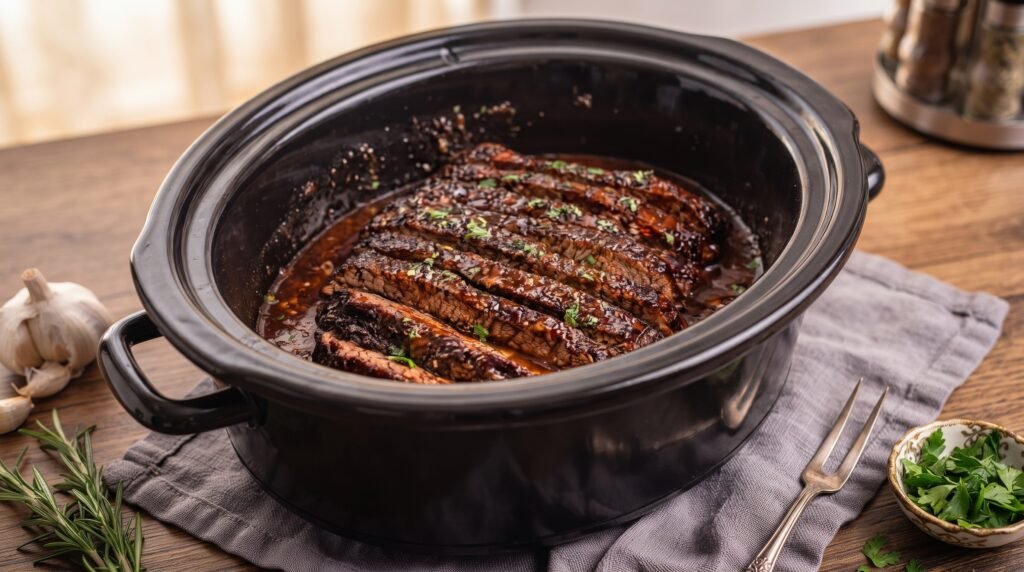
The photo above is the hard-won standard sitting on my counter: thick, perfectly sliced slabs of beef brisket nestled in an oval slow cooker, glistening under a thick, dark mahogany glaze flecked with herbs and caramelized garlic.
Here is how you make this incredible, melt-in-your-mouth slow-cooker beef brisket at home without ever suffering through tough, dry meat again.
Why Slow-Cooker Brisket Turns Tough (The Science of Collagen & Fiber)
Brisket is one of the most stubborn cuts of beef in the culinary world. When high heat meets dense connective tissue inside a closed steam chamber, simple mistakes will ruin your roast:
1. The “High Setting” Trap
A slow cooker’s High setting brings liquids up to a violent simmer (roughly 212°F / 100°C) far too quickly. Collagen only breaks down gently and converts into velvety gelatin between 180°F and 200°F (82°C to 93°C). When brisket is cooked at boiling temperatures, the protein strands contract violently, squeezing all internal moisture into the liquid. Cooking exclusively on Low for 8 to 9 hours gives the dense collagen time to relax and liquefy, basting the beef from the inside out until it turns succulent and tender.
2. Drowning the Meat in Broth
A slow cooker does not allow liquid to evaporate. As beef cooks, it naturally releases roughly twenty to twenty-five percent of its internal water. If you pour two or three cups of broth into the crock, you are not braising—you are boiling the meat. Boiling strips out flavor and leaves the meat pale and mushy. You only need ½ to ¾ cup of liquid at the bottom of the pot to create steam and prevent burning; the meat and melting fat will generate all the rich juices you need.
3. Slicing with the Grain
Beef brisket has long, visible, parallel muscle fibers running straight across the cut. If you slice your knife in the same direction as those fibers (with the grain), every bite will contain long, unbroken muscle strands that feel impossibly chewy in your mouth. Slicing strictly perpendicular to the grain (against the grain) shears those long strands into tiny fractions of an inch, meaning your teeth don’t have to do any work—the meat practically dissolves on your tongue.
Ingredients & Tools You’ll Need
Essential Kitchen Gear
- 6- to 7-Quart Oval Slow Cooker: (An oval ceramic slow cooker, like the black unit in the photo, provides the wide, flat base needed for a whole brisket flat to lie flat without curling up against the walls).
- 12-Inch Cast-Iron or Heavy Skillet: Mandatory for getting a blistering-hot, dark caramelized sear on both sides of the brisket before braising.
- Large Chef’s Knife or Carving Slicer: A long, razor-sharp blade ensures you can cut clean, even slices across the grain without tearing the tender meat fibers.
- Small Saucepan & Whisk: For reducing the slow-cooker pan drippings into a thick, glossy table glaze on the stovetop.
- Heavy Tongs & Carving Board: A sturdy cutting board with a juice groove catches any flavorful drippings during slicing.
The Ingredient Breakdown
| Component | Ingredient | Quantity | Practical Role |
| The Star Meat | Beef Brisket Flat (with a ¼-inch fat cap) | 3.5 to 4 lbs (trimmed) | Dense muscle packed with collagen that braises into fork-tender richness. |
| The Searing Fat | High-Smoke-Point Oil | 2 tbsp (avocado or canola oil) | Allows high-heat searing without scorching or smoking. |
| The Sweet Engine | Dark Brown Sugar | ⅓ cup (packed) | Caramelizes into that sticky, dark mahogany glaze seen in the photo. |
| The Acid Balance | Apple Cider Vinegar | 3 tbsp | Sharp fruit acidity that cuts through the rich beef fat and balances sugar. |
| Aromatic Core | Sweet Yellow Onion | 1 large (thickly sliced into rings) | Forms a protective vegetable bed in the crock to keep the meat off direct heat. |
| Aromatic Punch | Fresh Garlic Cloves | 6 cloves (minced) | Delivers robust, savory depth to the pan glaze. |
| Savory Backbone | Worcestershire Sauce | 2.5 tbsp | Fermented savory umami booster that anchors the barbecue profile. |
| The Liquid Base | Low-Sodium Beef Bone Broth | ¾ cup | Creates the initial steam cushion without over-diluting the glaze. |
| Smoky Depth | Smoked Paprika & Chili Powder | 1 tbsp smoked paprika, 1 tsp chili powder | Imparts authentic pit-smoked color and gentle warmth. |
| Aromatic Rub | Garlic Powder & Onion Powder | 1 tbsp each | Coats the exterior of the beef to build a savory caramelized crust. |
| Herbal Lift | Dried Thyme | 1 tsp | Earthy herbal note that rounds out the rich brown sugar glaze. |
| Base Seasoning | Coarse Kosher Salt & Coarse Black Pepper | 1.5 tbsp coarse salt, 1 tbsp coarse black pepper | Crucial seasoning across the brisket rub and pan reduction. |
| Glaze Thickener | Cornstarch Slurry | 1.5 tbsp cornstarch + 2 tbsp cold water | Thickens the braising drippings into that ultra-glossy, spoonable sauce. |
| Fresh Finish | Fresh Flat-Leaf Parsley | 2 tbsp (finely chopped) | Sprinkled across the sliced meat for color and clean contrast. |
Step-by-Step Cooking Instructions
Step 1: Trim and Season the Brisket
Take your beef brisket out of the refrigerator 30 to 45 minutes before cooking to take the deep chill off. Cold beef hitting a hot skillet drops the surface temperature, causing the meat to steam rather than develop a rich brown crust.
Lay the brisket flat on a cutting board, fat-cap side up.
Using a sharp boning or chef’s knife, trim the white fat cap down until it is an even ¼-inch thick.
Do not slice all the fat off! That layer of fat will slowly render downward through the meat during the braise, basting the muscle fibers and keeping the brisket succulent.
Pat the meat completely bone-dry on all sides with paper towels.
In a medium bowl, whisk together the dark brown sugar, smoked paprika, chili powder, garlic powder, onion powder, dried thyme, coarse kosher salt, and cracked black pepper.
Rub this spice blend aggressively over every square inch of the brisket, pressing firmly with your hands so the sugar and spices adhere to the meat fibers.
Step 2: The Hard Skillet Sear
Set your 12-inch heavy skillet over medium-high heat on the stovetop.
Add the 2 tablespoons of high-smoke-point oil.
Once the oil is shimmering hot, carefully lay the seasoned brisket into the skillet.
You should hear an immediate, loud sizzle.
Sear untouched for 3 to 4 minutes on the first side until the spices and brown sugar form a dark, caramelized, fragrant crust.
Use heavy metal tongs to carefully flip the brisket over.
Sear the second side for another 3 minutes.
Transfer the seared brisket to a clean plate.
Do not clean the skillet!
Step 3: Deglaze and Build the Braising Liquid
Turn the skillet heat down to medium-low.
Add the minced garlic to the residual pan drippings and sauté for 45 seconds until fragrant.
Pour in the ¾ cup of beef bone broth, 3 tablespoons of apple cider vinegar, and 2.5 tablespoons of Worcestershire sauce.
The liquid will bubble vigorously.
Use a flat wooden spatula to scrape firmly along the bottom of the skillet, loosening all the caramelized, browned beef bits (fond) stuck to the metal.
Let the liquid simmer for 2 minutes until smooth and uniform. Remove from heat.
Step 4: Layer and Load the Slow Cooker
Scatter your thickly sliced sweet yellow onions across the bottom of your 6-quart oval slow cooker insert.
This onion layer acts as a natural roasting rack, elevating the brisket slightly so it braises in hot steam rather than boiling in standing liquid.
Lay the seared brisket directly on top of the onions, fat-cap facing UP.
Pour the warm deglazing liquid from the skillet around the sides of the brisket into the bottom of the pot.
Important Visual Check: The liquid should only come up about a half-inch on the meat. It should never submerge the brisket!
Step 5: The Low-and-Slow Braise
Clamp the heavy lid onto the slow cooker.
- Cook on LOW for 8 to 9 hours.
The Non-Negotiable Rule: Do not open the slow cooker! For the first seven hours, resist the urge to lift the lid to peek or smell. Every time you remove the lid, you vent trapped steam and drop the internal temperature drastically, adding 20 to 30 minutes to your cook time.
Around the 8-hour mark, slide the tip of a paring knife or meat fork into the thickest center of the brisket: it should slide in effortlessly with almost zero resistance, yielding like soft butter.
If it feels tight or springy, clamp the lid back on and let it cook for another 45 minutes on Low.
Step 6: Rest, Slice, and Master the Grain
Once tender, use two pairs of tongs to carefully transfer the whole brisket from the slow cooker onto a large cutting board with a juice groove.
Tent the meat loosely with a sheet of aluminum foil.
Let the brisket rest untouched for 15 to 20 full minutes!
If you slice into hot brisket immediately, all the internal juices will pour out onto the board, leaving your meat dry and grey. Resting allows the muscle fibers to relax and reabsorb their internal moisture.
After resting, examine the surface of the meat to identify which way the long muscle fiber lines are running.
Using your sharp carving knife, slice the brisket strictly against the grain into thick, even slabs—roughly ¼-inch to ⅓-inch thick (exactly like the beautiful, defined slices pictured in the reference photo).
Step 7: Reduce the Glossy Pan Glaze
While the brisket rests on the cutting board, turn your attention to the rich pan juices inside the slow cooker.
Pour the warm cooking liquid through a fine-mesh strainer into a medium saucepan on your stovetop, pressing down on the soft cooked onions to extract all their sweet juices. Discard the spent onions.
Skim off the excess clear beef tallow floating across the surface with a shallow metal spoon so the glaze doesn’t turn greasy.
Set the saucepan over medium-high heat and bring the liquid to a rapid boil.
In a small cup, whisk together 1.5 tablespoons of cornstarch with 2 tablespoons of cold water until smooth.
Whisk the slurry into the boiling pan liquid.
Boil for 3 to 4 minutes, whisking constantly, until the liquid reduces and thickens into an ultra-luxurious, dark mahogany glaze that coats the back of a spoon like warm syrup.
Taste the glaze: it should be deeply savory, rich with beef fond, balanced by sweet brown sugar, and rounded out with tangy vinegar and garlic.
Step 8: Assemble and Serve in the Crock
Arrange your sliced brisket slabs back into the warm oval slow cooker, overlapping them in neat, cascading rows with the caramelized bark facing upward (exactly as seen in the photo).
Ladle the piping-hot, glossy brown sugar glaze generously over the sliced brisket, letting the sauce seep into every crevice between the meat slabs and fill the bottom of the pot.
Switch your slow cooker to the “WARM” setting.
Scatter finely chopped fresh Italian flat-leaf parsley across the top for a bright, vibrant green herbal contrast.
Serve warm directly from the rustic slow cooker at the table!
Practical Troubleshooting & Common Mistakes
- “My brisket turned out dry and rubbery.”
This happens if you cooked it on the “High” setting, or pulled it out too early. Brisket is tough until its internal collagen converts into liquid gelatin (usually around 200°F internal). Always cook on Low for a full 8 to 9 hours, and test for tenderness with a fork before pulling it out of the cooker. - “The meat shredded into ragged strings when I cut it.”
Two mistakes cause this: slicing while the meat is screaming hot, or slicing in the same direction as the grain. Always let the brisket rest for 15 to 20 minutes under foil, and always cut perpendicular to the grain with a sharp, non-serrated blade. - “The sauce separated into an oily slick.”
Brisket renders a significant amount of beef fat during an 8-hour braise. Always strain the cooking liquid into a saucepan and take two minutes to skim the surface fat off with a spoon before whisking in the cornstarch slurry.
Delicious Upgrades & Variations
While this classic brown sugar and garlic barbecue glaze is the gold standard for homestyle brisket, you can easily adapt the flavor profile:
- The Smoky Bourbon Glaze: Add ¼ cup of Kentucky bourbon to the deglazing liquid in Step 3. The oak and vanilla notes in the whiskey marry beautifully with the dark brown sugar and smoked paprika.
- The Spicy Chipotle Kick: Mince 2 chipotle peppers in adobo sauce and stir them directly into the braising liquid for a smoky, fiery Southwestern heat that cuts through the rich beef fat.
- The French Onion Brisket: Layer 3 large sliced yellow onions in the slow cooker with fresh thyme sprigs and 2 packets of dry onion soup mix mixed with beef broth. Skip the barbecue spices and finish with a rich onion jus.
What to Serve with Brown Sugar Glazed Brisket
This brisket is rich, savory, and produces plenty of sweet, garlicky pan glaze, making it the perfect centerpiece for classic barbecue accompaniments:
- Fluffy Mashed Potatoes or Buttered Egg Noodles: Spooning the tender brisket slices and generous ladles of that dark mahogany glaze over a mound of garlic mashed potatoes is pure comfort food heaven.
- Warm Brioche Slider Buns: Set out a basket of toasted brioche buns, dill pickle chips, and pickled red onions so guests can build their own brisket sandwiches.
- Crispy Southern Coleslaw: A cold, crunchy, buttermilk coleslaw provides a cool, tangy contrast that cuts right through the rich beef fat and sweet glaze.
- Roasted Corn on the Cob or Baked Beans: Classic barbecue sides that complement the smoky, brown sugar undertones of the brisket.
Storing and Reheating Leftovers (The Non-Dry Technique)
Leftover beef brisket is a culinary treasure, but you must protect it from drying out in the refrigerator.
Store leftover sliced brisket submerged in its pan glaze inside an airtight glass container for up to 4 days. The liquid acts as a protective barrier, preventing cold air from dehydrating the tender meat fibers.
Never reheat sliced brisket in the microwave on high power! The rapid radiation will instantly boil the remaining moisture out of the meat, turning your tender beef into rubbery, chewy leather.
Instead, use the gentle oven or skillet method:
- Place the leftover brisket slices and glaze into a baking dish or covered skillet.
- Splash in 2 to 3 tablespoons of beef broth or water if the glaze has thickened.
- Cover tightly with aluminum foil to trap steam.
- Warm in a 325°F (165°C) oven for 12 to 15 minutes until heated through to the center.
The meat will stay remarkably tender and juicy, the glaze will melt back into a glossy, sweet-and-savory lacquer, and you get to enjoy a restaurant-level barbecue feast all over again with practically zero effort!